Doctor of Medicine
Course code: MC-DMED

January
Commonwealth Supported Places (CSPs) available
Access Melbourne is available
January
AUD $122,976 (2026 indicative first year fee)
IELTS 7.0: with writing 7.0 and no other band less than 6.5
Course structure
Overview
The Doctor of Medicine (MD) is a four year full-time course comprising:
- One year of integrated bioscience and clinical learning featuring an innovative case-based teaching approach
- Two core clinical training years which facilitate learning with patients in a wide range of settings
- Discovery subjects which provide students flexibility to explore areas of particular interest
- The option to complete an immersive research experience in an area of interest
- A capstone semester in which you will "rehearse" the skills required for effective and safe clinical practice
- An annual medical conference which will provide opportunities to interact with leaders in research, policy and clinical healthcare.
Course Structure
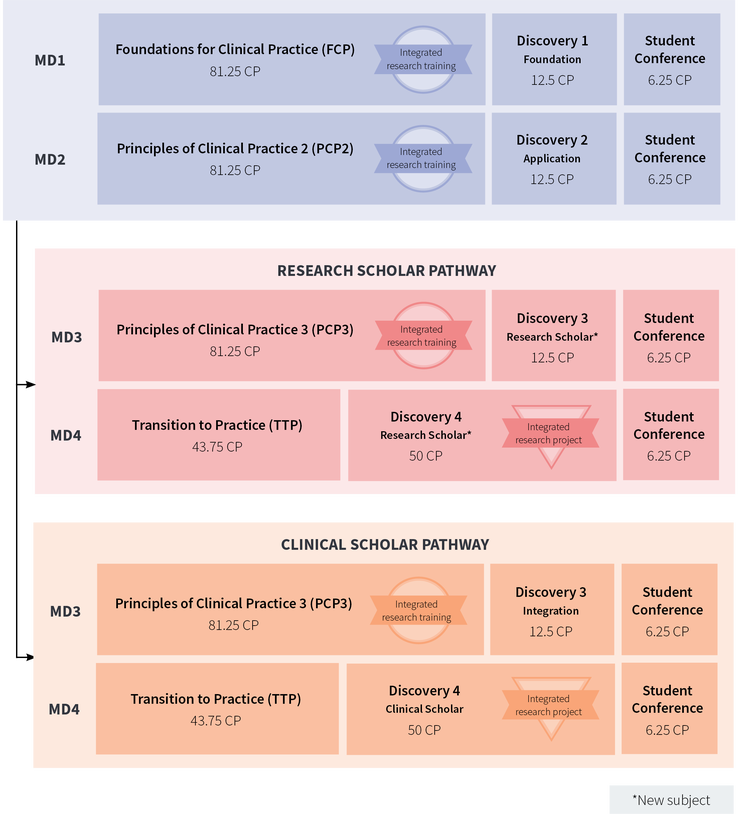
Further information on each of these subjects can be found in the Doctor of Medicine Handbook page.
Flexible Pathways
The redesigned Doctor of Medicine Course (MD) provides flexible pathways for you to meet the course core research
learning outcomes and includes the option to extend skills and scholarship by choosing either the Research Scholar
pathway or Clinical Scholar pathway.
Each pathway will broaden your skillset in either research skills and leadership (research scholarship pathway) or clinical advocacy and leadership (clinical scholarship pathway). Both pathways offer learning activities, projects and assessment tailored to meet and go beyond the course learning outcomes in your chosen area of interest.
During your second year, you will consider which pathway best meets your interests and career goals and choose either the Research Scholar pathway or the Clinical Scholar pathway. You will be supported in this decision-making process by an experienced team of Course Advisors.
Discovery subjects
Discovery will enable you to look deeper into an area aligned with the core curriculum that has piqued your curiosity.
- In year 1 of discovery, you’ll lay the foundation of knowledge and understanding (Discovery 1 - Foundation)
- In year 2, you’ll be applying your learning to the clinical setting (Discovery 2 - Application)
- In year 3, you’ll be integrating multiple concepts into your practice of medicine (Discovery 3 - Integration OR Discovery 3 - Research Scholar)
- In year 4, your discovery subject culminates in using what you’ve learned to create something new (Discovery 4 - Clinical Scholar OR Discovery 4 - Research Scholar)
Intercalated pathway options
Eligible students may apply, following admission into the MD, to intercalate either a PhD, Master of Public Health or Master of Biomedical Engineering with their MD studies. Please see the below pages for information, including the eligibility criteria, for each of these intercalated pathways.
Explore this course
Explore the subjects you could choose as part of this degree.
Students complete all of the following compulsory Year 1 subjects:
Year 1 - core
| Accordion | |
|---|---|
| Foundations for Clinical Practice · 81.25 pts |
Foundations for Clinical Practice introduces students to the scientific knowledge and clinical skills required for medical practice. Core content covered includes foundational biomedical science knowledge and clinical communication and examination skills as well as a focus on early professional identity formation. Throughout the year, students work towards establishing introductory level clinical competencies while working under the guidance of tutors from a mixture of scientific and clinical professions. Students are expected to actively participate in a variety of different learning activities, both online and in person. These include webinars, interactive modules, tutorials, practical classes and clinical placements. Biomedical science knowledge is introduced and consolidated through small group exploration of clinically focused cases, which provide the context for understanding how major body system’s structure and function contribute to patient health and well-being. Clinical skills are developed through use of peer learning, simulation and longitudinal community and hospital based clinical placements. A body systems approach guides learning throughout the year and emphasis is placed on three main streams of learning: Biomedical science knowledge; clinical skills; and professionalism in practice. |
| Student Conference 1 · 6.25 pts |
The Student Conference is a one-week intensive subject that brings students together across all years and sites for a student led and driven conference. The aim of the Student Conference is to allow students to learn from each other, experts in various fields and other health professionals in topic areas suited to a conference format. In first year students will attend and actively participate in the conference program. |
Year 2 - core
| Accordion | |
|---|---|
| Principles of Clinical Practice 2 · 81.25 pts |
The overall aim of Principles of Clinical Practice 2 is to further develop applied biomedical knowledge, key clinical skills, and clinical reasoning in a full-time clinical environment. Students are expected to actively participate in a variety of different learning activities both online and in person, and to actively engage in clinical placement. The subject will be delivered in four-week terms. Over the course of the year students will be on clinical placement in adult medicine, surgery, anaesthesia, and emergency and will focus on becoming part of hospital-based teams to help them develop their diagnostic and therapeutic skills in the context of the patients presenting with acute and chronic medical and surgical conditions. Teaching activities include interactive modules that allow students to apply biomedical knowledge, clinical skills and clinical reasoning to develop a differential diagnosis and provide a management plan on core conditions and presentations; simulation exercises focused on the deteriorating patient; intensive clinical skills coaching, oral presentations of patient assessment findings and professional practice development. |
| Student Conference 2 · 6.25 pts |
The Student Conference is a one week intensive subject that brings students together across all years and sites for a student led and driven conference. The aim of the Student Conference is to allow students to learn from each other, experts in various fields and other health professionals in topic areas suited to a conference format. In second year students will attend, actively participate in the conference program and provide peer review, as well as having the opportunity to teach, present and be actively involved in conference organisation. |
Year 3 - core
| Accordion | |
|---|---|
| Principles of Clinical Practice 3 · 81.25 pts |
The overall aim of Principles of Clinical Practice 3 is to further develop applied biomedical knowledge, key clinical skills, and clinical reasoning in a broad range of clinical settings and medical disciplines. Students are expected to actively participate in a variety of different learning activities both online and in person, and to actively engage in clinical placement. The subject will be delivered in five 6-week terms. Over the course of the year students will be on clinical placement in General Practice, Mental health, Aged Care, Rehabilitation, Palliative Care, Child and Adolescent Health and Women’s Health. Students will build on their understanding of health systems and teams and their understanding of transitions of care. Students will focus on becoming part of hospital-based and community-based teams to further develop their diagnostic, communication and management skills in the context of patients presenting with acute and chronic conditions in all age groups. Teaching activities include interactive modules that allow students to apply biomedical knowledge, clinical skills and clinical reasoning to develop a differential diagnosis and provide a management plan for core conditions and presentations; and understand risk assessment in health care and the role of preventative care, professional practice development and procedural skills training. |
| Student Conference 3 · 6.25 pts |
The Student Conference is a one-week intensive subject that brings together students across all Doctor of Medicine (MD) years and sites for a student led and driven conference. The aim of the Student Conference is to allow students to learn from each other, experts in various fields and other health professionals in topic areas suited to a conference format. In third year students will attend, actively participate in the conference program and provide peer review, as well as having the opportunity to teach, present and be actively involved in conference organisation. |
Year 4 - core
| Accordion | |
|---|---|
| Transition to Practice · 43.75 pts |
Transition to Practice is the clinical capstone subject for the Doctor of Medicine. The overall aim is to draw together students’ learning in the context of contemporary health care delivery from their experiences across the course and prepare students for the next phases of their medical training (prevocational and vocational). Students are expected to actively participate and engage in the different learning activities and to be an active, contributing member of the healthcare team they are placed with. Transition to Practice is a full-time clinical placement subject that will be delivered in four 4-week clinical placements with embedded additional teaching and learning activities. Students will achieve pre-intern competencies by being fully immersed in the clinical environment and demonstrating these competencies on placement. Teaching and learning activities will connect students’ prior learning throughout the MD program to the delivery of safe and effective practice. Teaching activities will include a variety of approaches including simulation, small group tutorials, online learning and practical sessions. |
| Student Conference 4 · 6.25 pts |
The Student Conference is a one-week intensive subject that brings together students across all Doctor of Medicine (MD) years and sites for a student led and driven conference. The aim of the Student Conference is to allow students to learn from each other, experts in various fields and other health professionals in topic areas suited to a conference format. In fourth year, students will attend, actively participate in the conference program and provide peer review, as well as having the opportunity to teach, present and be actively involved in conference organisation. A particular feature of Student Conference 4 will be the presentation of papers and posters reporting projects undertaken in the MD Scholar pathways. |
Plus one of the following Year 1 selectives
Year 1 - selectives
| Accordion | |
|---|---|
| MD Discovery 1: Foundation · 12.5 pts |
This subject is the first in a series of four MD Discovery subjects embedded within the Doctor of Medicine course. Students will engage in 87.5 credit points of discovery-based learning in areas of interest across their course. Discovery learning allows medical students to engage in flexible, personalised and increasingly complex situational learning as they progress, providing opportunities to reflect on the professional practice of medicine in a variety of contexts and settings. |
| Biostatistics · 12.5 pts |
This subject is compulsory for students enrolled in the Master of Public Health, Master of Epidemiology and the Master of Science (Epidemiology). Students should enrol in this subject early in their program of study. |
| Epidemiology 1 · 12.5 pts |
This subject is a core subject within the Master of Public Health, the Master of Epidemiology, the Master of Science (Epidemiology) and the Master of Biostatistics. Students should enrol in this subject early in their program of study. Epidemiology is the study of the distribution and determinants of disease frequency in human populations and the application of this study to control health problems. It is a fundamental science of public health. Three main tasks of epidemiology include description, causal inference and prediction. This subject focuses on the first two and emphasises the application of epidemiological evidence to informing public health practice and policy. Description: the epidemiological measures of disease frequency and summary measures of population health are introduced and used to describe patterns and trends in disease occurrence within and between populations. The role of routinely collected data, particularly for surveillance of infectious diseases, is discussed. Causal inference: is key to applying epidemiological evidence to controlling health problems if interventions are to be effective. In this subject, causal inference is considered within the modern counterfactual framework. Causal diagrams, which are an integral part of this approach to causal inference are introduced. The common experimental and observational study designs, and systematic reviews, and their relative strengths and weaknesses are discussed. The implications of common types of bias (selection bias, information bias, and confounding) are discussed, as are methods to minimise them. Methods to control for confounding, including standardisation, are discussed. Differences in characteristics of the major sources of morbidity (infectious disease, non-communicable disease, and injury) are discussed in the context of prevention and early detection of disease. Transmission dynamics of infectious diseases are introduced in this context. The applicability of epidemiological evidence (external validity) to interventions in target populations is introduced. Measures of the validity and performance of tests for early detection are introduced. |
| Health Economics 1 · 12.5 pts |
This subject introduces students to health economics as a sub-discipline of economics. Students are provided with a comprehensive introduction to micro-economics, so the subject is suitable for students with no prior knowledge of economics. It paves the way for students to apply micro-economic concepts to the analysis of contemporary issues in public health and health care. Topics to be studied include the following:
|
| Foundations of Public Health · 12.5 pts |
This subject is a compulsory subject within the Master of Public Health. It lays the foundation for the degree and provides an orientation to the field of public health. It provides a critical overview of public health historical development, conceptual underpinnings and practice in the following domains. History and distinguishing features of public health and population health: The historical development of public health is traced. The distinguishing features of public health, emphasising the health of groups and populations rather than a focus on the health of an individual, are presented and explored. Key points of transition in the health of populations over time are identified. The scientific disciplines that make up the toolbox of modern population health are described. Determinants of the health of individuals, groups and populations: Determinants of health affecting the health of individuals, and populations are identified, recognising that social determinants work in concert with environmental and biological factors. The health of Indigenous people in Australia is examined and resources provided to assist in understanding common influences on the health of Indigenous people world-wide. The increasing importance of health and human rights locally and globally is discussed, including an examination of the ethical frameworks relevant to public health practice. Strategies and Systems: Major strategies and approaches to public health including health protection, health improvement and health care quality assessment are presented, with illustrations from local and international experience. The elements and function of health systems are defined and the roles of principal public health agencies internationally and nationally are described. Achievements and challenges: The significant achievements in public health from the late 20 th century through to the 21 st century are identified and emerging challenges and possible solutions are explored, including in relation to Indigenous populations. |
| Planetary and Global Health · 12.5 pts |
Improving global health in the long term requires a deep appreciation of the impact of environmental issues at local, national and global scales. To facilitate depth of learning, this subject focuses on five key public health threats that require complex multidisciplinary solutions, which are: climate change; poor sanitation and water security; nuclear weapons; air pollution and COVID-19. Students of this subject will explore these interrelated planetary challenges, their profound implications for population health, and the demand for high level integrated problem solving in the coming decades. Students will become familiar with and critique relevant policies and international agreements pertaining to environmental health. Students will also learn to identify complex systems and barriers implicated in processes of responding to environmental challenges on global, national and local scales. This subject involves interactive sessions and is facilitated by internationally recognised experts in this field. Planetary and Global Health is a dual delivery block mode intensive subject. This means that the assessable material is delivered through self-directed online modules that students complete over a two-week period. The online modules offer flexibility in relation to the timing of when students complete them, or what hours of the day you may choose to study. However, allocated modules must be completed in time to allow effective participation in live interactive sessions that are linked with those modules. Live interactive sessions are held on six days across the two week period, in which module material is discussed with fellow students and lecturers. Students may choose to attend these live sessions online or face to face. Students are expected to commit approximately 40 hours to learning each week, comprised of learning modules, reading, discussion board activities, group work and live sessions. This two-week teaching period is followed by group work and independent learning towards three pieces of assessment to be completed over four weeks. |
| Non Communicable Disease & Global Health · 12.5 pts |
Globally, non communicable diseases account for over two thirds of all deaths, and over half of disability adjusted life years. While non communicable diseases have sometimes been assumed to impact only on wealthy countries, they are in fact a major health and development challenge. Around 80 percent of non communicable disease-related deaths occur in low and middle income countries. Nations with the highest non communicable disease burden include some of Australia’s closest neighbours, particularly island states in the Pacific, where over 70 percent of mortality is now due to non communicable diseases. The growing non communicable disease burden is of critical importance to global health and development because it impacts on economic growth, increases levels of poverty, and leads to premature death. Non communicable diseases also have major social and fiscal implications for governments and communities. In this subject, students will gain a practical understanding of the epidemiology, determinants, consequences and global health responses to the non communicable disease epidemic. The subject promotes students’ exploration of the nexus between non communicable diseases and disability, non communicable diseases and infectious diseases, and non communicable diseases within the broader public health and global development agenda. The subject will contribute to enabling a new generation of public health professionals to address non communicable diseases through appropriate policy, programmatic and advocacy responses in Australia and globally. Non Communicable Disease & Global Health is a dual delivery block mode intensive subject. This means that the assessable material is delivered through self-directed online modules that students complete over a two-week period. The online modules offer flexibility in relation to the timing of when students complete them, or what hours of the day you may choose to study. However, allocated modules must be completed in time to allow effective participation in live interactive sessions that are linked with those modules. Live interactive sessions are held on six days across the two-week period, in which module material is discussed with fellow students and lecturers. Students may choose to attend these live sessions online or face to face. Students are expected to commit approximately 40 hours to learning each week, comprised of learning modules, reading, discussion board activities, group work and live sessions. This two-week teaching period is followed by independent learning towards two pieces of assessment to be completed over six weeks. |
| Bioethics in Practice · 12.5 pts |
This subject introduces students to ethical decision-making, with a focus on health. It explores ethical issues in public health and clinical care, in both Australian and global contexts. Students will be introduced to frameworks for making rigorous ethical decisions in practice, and learn skills for analysing ethical problems across diverse types of health work and in interprofessional groups. Topics include: vaccination, voluntary assisted dying, reproduction, children’s healthcare, and resource allocation. |
| Population Mental Health · 12.5 pts |
Mental health is a key public health priority. Mental health conditions have a substantial impact on individuals, families and society worldwide, making them a leading cause of disease burden globally. Many mental health conditions can be prevented and/or treated with effective mental health promotion, prevention, treatment and rehabilitation strategies at the population level. This subject is an introduction to the field of population mental health and will provide an overview of the trends and determinants of mental health; the inter-connection between mental health and physical health; its association with socio-cultural factors; its differential conceptualisation and manifestations across cultures; the individual, familial, societal and global implications of mental disorders; leading contemporary frameworks, theories and approaches to mental health system development and implementation; and the importance of a holistic and whole-of-society approach. The subject will highlight the critical role of the community and society in supporting people with mental health conditions. Students will be introduced to some of the major initiatives in this area both within Australia and overseas by experts in these fields. |
| Climate Change and Health · 12.5 pts |
This subject will teach students the fundamental links between climate, climate change and human health. Students will be exposed to the global frameworks underpinning climate change and human health, including widely used decision-support tools such as Vulnerability and Capacity Assessments. Themes will include justice, co-design of solutions and how human health links in with Climate Resilient Development (CRD). The latest Intergovernmental Panel on Climate Change (IPCC) assessment will form a core basis for the subject, along with WHO guidance materials and panel discussions with policymakers, practitioners and researchers. |
| Sustainability and Healthcare · 12.5 pts |
Human social, mental and economic health is intimately connected with, both positively and negatively, our footprints on the earth. The healthcare system and associated professions are (i) contributors to the problem of anthropogenic climate change, (ii) are impacted by it and are (iii) part of the solution towards a more sustainable society. This subject recognises the need to urgently formulate adaptation and mitigation strategies, thereby addressing the global climate change emergency, through the lens of sustainable healthcare. Key themes, with reference to case studies and student tasks, include: • The existing and anticipated impacts of anthropogenic climate change on patients, practitioners and the healthcare system • Approaches to climate change adaptation and mitigation that incorporate nuanced application of systems thinking and design principles, as well as good governance practices • Evaluation of the various elements of sustainability practice in different healthcare settings and services, including community, hospital and laboratory contexts, using local, national and international examples and experts • Consideration of the barriers and facilitators, as well as co-benefits, of system change towards more sustainable healthcare, including the commercial determinants of health • Analysis and application of the principles of transformation of linear to circular economies, and the role of lifecycle analysis in promoting low carbon, but high value, healthcare • Linkage of climate change and sustainability with other health equity issues, within determinants of health framework, of intersectionality, allyship and co-benefits for disadvantaged groups |
| Digital Transformation of Health · 12.5 pts |
Healthcare is information intensive. Health data are generated, shared, consumed, and stored in a variety of partially overlapping complex networks. Healthcare lags behind many other sectors, despite efforts to use digital technologies to shape and improve health data and information processes since the middle of the 20th Century. The need for digital transformation of health is driven by socio-economic concerns (making healthcare more accessible and affordable) and patient safety (reducing medical errors, and redundant and ineffective interventions). This subject introduces the background, current state, and future opportunities of digital health. It provides a basic understanding of health and disease and how individuals experience both. It explores the nature of biomedical data, information, and knowledge - and how digital technologies are shaping the way these are used. Digital health technologies are examined from ethical, historical, technological, and psycho-social perspectives, considering positive and negative impacts. |
| Digital Learning Health Systems · 12.5 pts |
Nearly 40% of healthcare costs can be attributed to wastage and harm. At the same time, digital health and informatics is generating rich and valuable data that can be used to generate insights and improve the quality of care, enhance patient-centred care, as well as dramatically increase value-based care. While, on average, it takes 17 years for research to translate and have impact in the clinical setting, the Learning Health System framework allows for immediate real-time interrogation of data and implementation of knowledge gained in rapid quality improvement cycles, to ultimately improve patient outcomes. This subject will enable students to simulate and reflect on a Learning Healthcare System approach to a health service digital transformation project; to use digital patient data to gain new knowledge about a problem; to use this knowledge to inform a digital innovation in practice; and to use the ensuing practice-based evidence to guide digital health management decisions. These concepts will be taught through the lens of a real-world digital health intervention case study and the toolkit approach provides a framework to apply to the learners’ workplace endeavours. |
Year 2 - selectives
| Accordion | |
|---|---|
| MD Discovery 2: Application · 12.5 pts |
This subject provides a range of Discovery choices for students entering their second year of medical studies. This subject, “MD Discovery 2: Application” is usually taken in the second year of the Melbourne MD and is intended to give students further insights into an area about which they are passionate and that may be built on in subsequent years if desired. Or, it can provide a stand-alone learning experience. |
| Climate Change and Health · 12.5 pts |
This subject will teach students the fundamental links between climate, climate change and human health. Students will be exposed to the global frameworks underpinning climate change and human health, including widely used decision-support tools such as Vulnerability and Capacity Assessments. Themes will include justice, co-design of solutions and how human health links in with Climate Resilient Development (CRD). The latest Intergovernmental Panel on Climate Change (IPCC) assessment will form a core basis for the subject, along with WHO guidance materials and panel discussions with policymakers, practitioners and researchers. |
| Sustainability and Healthcare · 12.5 pts |
Human social, mental and economic health is intimately connected with, both positively and negatively, our footprints on the earth. The healthcare system and associated professions are (i) contributors to the problem of anthropogenic climate change, (ii) are impacted by it and are (iii) part of the solution towards a more sustainable society. This subject recognises the need to urgently formulate adaptation and mitigation strategies, thereby addressing the global climate change emergency, through the lens of sustainable healthcare. Key themes, with reference to case studies and student tasks, include: • The existing and anticipated impacts of anthropogenic climate change on patients, practitioners and the healthcare system • Approaches to climate change adaptation and mitigation that incorporate nuanced application of systems thinking and design principles, as well as good governance practices • Evaluation of the various elements of sustainability practice in different healthcare settings and services, including community, hospital and laboratory contexts, using local, national and international examples and experts • Consideration of the barriers and facilitators, as well as co-benefits, of system change towards more sustainable healthcare, including the commercial determinants of health • Analysis and application of the principles of transformation of linear to circular economies, and the role of lifecycle analysis in promoting low carbon, but high value, healthcare • Linkage of climate change and sustainability with other health equity issues, within determinants of health framework, of intersectionality, allyship and co-benefits for disadvantaged groups |
| Bioethics in Practice · 12.5 pts |
This subject introduces students to ethical decision-making, with a focus on health. It explores ethical issues in public health and clinical care, in both Australian and global contexts. Students will be introduced to frameworks for making rigorous ethical decisions in practice, and learn skills for analysing ethical problems across diverse types of health work and in interprofessional groups. Topics include: vaccination, voluntary assisted dying, reproduction, children’s healthcare, and resource allocation. |
| Biostatistics · 12.5 pts |
This subject is compulsory for students enrolled in the Master of Public Health, Master of Epidemiology and the Master of Science (Epidemiology). Students should enrol in this subject early in their program of study. |
| Epidemiology 1 · 12.5 pts |
This subject is a core subject within the Master of Public Health, the Master of Epidemiology, the Master of Science (Epidemiology) and the Master of Biostatistics. Students should enrol in this subject early in their program of study. Epidemiology is the study of the distribution and determinants of disease frequency in human populations and the application of this study to control health problems. It is a fundamental science of public health. Three main tasks of epidemiology include description, causal inference and prediction. This subject focuses on the first two and emphasises the application of epidemiological evidence to informing public health practice and policy. Description: the epidemiological measures of disease frequency and summary measures of population health are introduced and used to describe patterns and trends in disease occurrence within and between populations. The role of routinely collected data, particularly for surveillance of infectious diseases, is discussed. Causal inference: is key to applying epidemiological evidence to controlling health problems if interventions are to be effective. In this subject, causal inference is considered within the modern counterfactual framework. Causal diagrams, which are an integral part of this approach to causal inference are introduced. The common experimental and observational study designs, and systematic reviews, and their relative strengths and weaknesses are discussed. The implications of common types of bias (selection bias, information bias, and confounding) are discussed, as are methods to minimise them. Methods to control for confounding, including standardisation, are discussed. Differences in characteristics of the major sources of morbidity (infectious disease, non-communicable disease, and injury) are discussed in the context of prevention and early detection of disease. Transmission dynamics of infectious diseases are introduced in this context. The applicability of epidemiological evidence (external validity) to interventions in target populations is introduced. Measures of the validity and performance of tests for early detection are introduced. |
| Foundations of Public Health · 12.5 pts |
This subject is a compulsory subject within the Master of Public Health. It lays the foundation for the degree and provides an orientation to the field of public health. It provides a critical overview of public health historical development, conceptual underpinnings and practice in the following domains. History and distinguishing features of public health and population health: The historical development of public health is traced. The distinguishing features of public health, emphasising the health of groups and populations rather than a focus on the health of an individual, are presented and explored. Key points of transition in the health of populations over time are identified. The scientific disciplines that make up the toolbox of modern population health are described. Determinants of the health of individuals, groups and populations: Determinants of health affecting the health of individuals, and populations are identified, recognising that social determinants work in concert with environmental and biological factors. The health of Indigenous people in Australia is examined and resources provided to assist in understanding common influences on the health of Indigenous people world-wide. The increasing importance of health and human rights locally and globally is discussed, including an examination of the ethical frameworks relevant to public health practice. Strategies and Systems: Major strategies and approaches to public health including health protection, health improvement and health care quality assessment are presented, with illustrations from local and international experience. The elements and function of health systems are defined and the roles of principal public health agencies internationally and nationally are described. Achievements and challenges: The significant achievements in public health from the late 20 th century through to the 21 st century are identified and emerging challenges and possible solutions are explored, including in relation to Indigenous populations. |
| Health Economics 1 · 12.5 pts |
This subject introduces students to health economics as a sub-discipline of economics. Students are provided with a comprehensive introduction to micro-economics, so the subject is suitable for students with no prior knowledge of economics. It paves the way for students to apply micro-economic concepts to the analysis of contemporary issues in public health and health care. Topics to be studied include the following:
|
| Non Communicable Disease & Global Health · 12.5 pts |
Globally, non communicable diseases account for over two thirds of all deaths, and over half of disability adjusted life years. While non communicable diseases have sometimes been assumed to impact only on wealthy countries, they are in fact a major health and development challenge. Around 80 percent of non communicable disease-related deaths occur in low and middle income countries. Nations with the highest non communicable disease burden include some of Australia’s closest neighbours, particularly island states in the Pacific, where over 70 percent of mortality is now due to non communicable diseases. The growing non communicable disease burden is of critical importance to global health and development because it impacts on economic growth, increases levels of poverty, and leads to premature death. Non communicable diseases also have major social and fiscal implications for governments and communities. In this subject, students will gain a practical understanding of the epidemiology, determinants, consequences and global health responses to the non communicable disease epidemic. The subject promotes students’ exploration of the nexus between non communicable diseases and disability, non communicable diseases and infectious diseases, and non communicable diseases within the broader public health and global development agenda. The subject will contribute to enabling a new generation of public health professionals to address non communicable diseases through appropriate policy, programmatic and advocacy responses in Australia and globally. Non Communicable Disease & Global Health is a dual delivery block mode intensive subject. This means that the assessable material is delivered through self-directed online modules that students complete over a two-week period. The online modules offer flexibility in relation to the timing of when students complete them, or what hours of the day you may choose to study. However, allocated modules must be completed in time to allow effective participation in live interactive sessions that are linked with those modules. Live interactive sessions are held on six days across the two-week period, in which module material is discussed with fellow students and lecturers. Students may choose to attend these live sessions online or face to face. Students are expected to commit approximately 40 hours to learning each week, comprised of learning modules, reading, discussion board activities, group work and live sessions. This two-week teaching period is followed by independent learning towards two pieces of assessment to be completed over six weeks. |
| Planetary and Global Health · 12.5 pts |
Improving global health in the long term requires a deep appreciation of the impact of environmental issues at local, national and global scales. To facilitate depth of learning, this subject focuses on five key public health threats that require complex multidisciplinary solutions, which are: climate change; poor sanitation and water security; nuclear weapons; air pollution and COVID-19. Students of this subject will explore these interrelated planetary challenges, their profound implications for population health, and the demand for high level integrated problem solving in the coming decades. Students will become familiar with and critique relevant policies and international agreements pertaining to environmental health. Students will also learn to identify complex systems and barriers implicated in processes of responding to environmental challenges on global, national and local scales. This subject involves interactive sessions and is facilitated by internationally recognised experts in this field. Planetary and Global Health is a dual delivery block mode intensive subject. This means that the assessable material is delivered through self-directed online modules that students complete over a two-week period. The online modules offer flexibility in relation to the timing of when students complete them, or what hours of the day you may choose to study. However, allocated modules must be completed in time to allow effective participation in live interactive sessions that are linked with those modules. Live interactive sessions are held on six days across the two week period, in which module material is discussed with fellow students and lecturers. Students may choose to attend these live sessions online or face to face. Students are expected to commit approximately 40 hours to learning each week, comprised of learning modules, reading, discussion board activities, group work and live sessions. This two-week teaching period is followed by group work and independent learning towards three pieces of assessment to be completed over four weeks. |
| Population Mental Health · 12.5 pts |
Mental health is a key public health priority. Mental health conditions have a substantial impact on individuals, families and society worldwide, making them a leading cause of disease burden globally. Many mental health conditions can be prevented and/or treated with effective mental health promotion, prevention, treatment and rehabilitation strategies at the population level. This subject is an introduction to the field of population mental health and will provide an overview of the trends and determinants of mental health; the inter-connection between mental health and physical health; its association with socio-cultural factors; its differential conceptualisation and manifestations across cultures; the individual, familial, societal and global implications of mental disorders; leading contemporary frameworks, theories and approaches to mental health system development and implementation; and the importance of a holistic and whole-of-society approach. The subject will highlight the critical role of the community and society in supporting people with mental health conditions. Students will be introduced to some of the major initiatives in this area both within Australia and overseas by experts in these fields. |
| Ageing Health & Human Services · 12.5 pts |
This course explores the interface of policy and practice in the delivery of aged care services. The responses to policy shifts in aged care over time will be explored. The course will then focus on the present day impact of health care, mental health, income security, housing, and employment, educational and recreational policies on the delivery of services to older citizens collectively and as individuals. Case studies will be used to illustrate both the theoretical and practical aspects of designing and delivering services. |
| Body of Ageing · 12.5 pts |
This subject focuses on how the body and its systems are affected by ageing and explores the differences between the natural ageing process and physical changes that develop as a result of illness with older persons. Students will also examine the effects of the environment and lifestyle factors on musculoskeletal, cardiorespiratory and neurological systems that contribute to the experience of ageing and to the individual’s capability to engage with their participation preferences. Understanding the common impairments and physiological changes behind them that occur as part of ageing process provides students with a fundamental base to critically analyse as well as develop strategies for healthy ageing and disease prevention. |
| Design for Ageing · 12.5 pts |
Demographic ageing is creating a shift in how to think and define homes, cities and public spaces. This subject explores feasible and sustainable approaches to keep the older segment of the population physically and socially active. Innovative changes in design can lead to significant advancements in service delivery, transportation models and homes that allow people to age in place. In addition, design principles for dementia and palliative care are a few of the many concepts that help minimise stress on people as they age and their families. Students will explore these topics and develop their own ideas about the way design can optimise the ageing process for comfort, security and overall well-being. |
| Gender and Health · 12.5 pts |
Gender is one of the most influential social determinants of health globally. In this subject, students will develop an understanding of gender as a social construct distinct from biological sex and explore the role of gender in shaping health inequities. Through critical analysis of research, theory and real-world case studies, students will apply gender concepts and gender analysis to pressing global health challenges including transgender health, genital modification practices and gender-based violence. This subject adopts a non-binary approach to understanding and examining gender and is grounded in a social determinants of health framework. It encourages students to apply an intersectional focus by considering how gender intersects with other social identities, such as race, sexuality and disability, to impact on the health of individuals, communities and populations. |
| Health Indicators and Health Surveys · 12.5 pts |
This subject introduces students to a variety of sources of routinely collected health-related data and how these data are used to derive population measures of fertility, mortality and morbidity, and to measure health service utilisation, disease registration and reporting. You will also learn how to develop, design and deliver a valid and reliable health questionnaire, and how to design and implement a survey using an efficient sampling strategy, and to analyse and interpret the resulting data. Topics include: routinely collected health-related data; quantitative methods in demography, including standardisation and life tables; health differentials; design and analysis of population health surveys, including the role of stratification, clustering and weighting. |
| Health Policy · 12.5 pts |
The subject explores the policy decisions, usually made by governments, that determine present and future country or regional level objectives relating to health services; programs; and the regulatory, organisational, social, cultural, physical and natural environments that contribute to population health and well-being. The subject explores the nature of health policy, types of policy instruments, and policy making processes including agenda setting and policy influencing frameworks and theories. The role of evidence in policy formation including the significance of the balance between effectiveness, efficiency and equity as objectives of health policy will be debated. In doing so, students will be introduced to the importance and process of policy analysis and explore the relevant legal, political, managerial, sociological, ethical, epidemiological and economic perspectives to instrument selection and policy implementation across a range of health policy contexts. Australian and international country contexts will be used throughout the subject. |
| Health Program Evaluation 1 · 12.5 pts |
This subject examines the diverse purposes health program evaluations can serve and the wide range of environments in which health program evaluations are conducted. Using Australian and overseas evaluation examples, students gain an overview of conceptual and methodological issues in the key evaluation approaches. The three major stages in the conduct of an evaluation are covered: planning and negotiating the terms and design of the evaluation; data collection and analysis; and the provision of findings. Each stage is considered through example and critique of those examples, with opportunities to apply these skills in the development of an evaluation plan for a real, work-based program. |
| Introduction to Statistical Computing · 12.5 pts |
The aim of this subject is to equip students with the knowledge and skills required for moderate to high level data manipulation and management in preparation for statistical analysis of data typically encountered in health and medical research. Students will gain hands-on experience with two major statistical software packages (Stata and R), learning to efficiently manage and manipulate data, display and summarize data, check and clean datasets, and link files using unique and non-unique identifiers. Additionally, students will acquire fundamental graphing and programming skills for each of these software packages and will be introduced to key principles of confidentiality and privacy in data storage, management, and analysis. |
| Primary Health Care: applied principles · 12.5 pts |
The 1978 Alma Ata Declaration was a watershed moment in the development of health systems globally. It influenced the evolution of primary health care (PHC) and health practice, especially community and global health. This subject will cover the principles and approaches of community-based PHC with particular focus on the broader influence of PHC across health systems and achieving positive outcomes for all; specifically the most vulnerable and in-need. The core focus of the subject is on the principles of PHC as enshrined in the Alma Ata declaration and how they have been applied in practice with specific emphasis on the evidence for effectiveness and critical review of when, how and whether they should be applied. Engaging with the history, principles, and key elements of PHC, students will examine the various roles of community health groups, and workers' approaches to disease control; the role of global agencies and local health systems; contemporary applications of the principles of PHC across low, middle, and high-income settings highlighting the need for equitable access; and the current demographic and epidemiological trends PHC is challenged to address. Drawing on global case studies and experience presented by experts with extensive applied experience, students will acquire a comprehensive understanding of the theory and practice of individual and community participation in PHC, as well as integrated, multi-sectoral and equity-based approaches to achieving improved health. Students will develop the skills and strategies to critically examine PHC approaches and program design, and the current health and health system trends influencing community based PHC globally. ‘Primary Health Care: applied principles’ is a dual delivery block mode intensive subject. This means that the assessable material is delivered through self-directed online modules that students complete over a two-week period. The online modules offer flexibility in relation to the timing of when students complete them, or what hours of the day you may choose to study. However, allocated modules should be completed in time to allow effective participation in live interactive sessions that are linked with those modules. Live interactive sessions are held on six days across the two-week period, in which module material is discussed with fellow students and lecturers. Students may choose to attend these live sessions online or face to face. Students are expected to commit approximately 40 hours to learning each teaching week, comprised of learning modules, reading, discussion board activities, group work and live sessions. This two-week teaching period is followed by group work and independent learning towards three pieces of assessment to be completed over six weeks. This subject is a Melbourne located alternative to POPH90137 “Primary Health Care in Jamkhed, India”. Students may not take both subjects. |
| Qualitative Research in Public Health · 12.5 pts |
This is a compulsory subject in the Master of Public Health. Qualitative research plays an important role in public health as it can explain how people experience a particular health issue or why they perform a health-related behavior, taking into account specific social, political and economic contexts. Public health practitioners need to be able to undertake and interpret a range of published research (including qualitative research) in order to gather evidence for practice, identify gaps in evidence and evaluate current practice. |
| Digital Transformation of Health · 12.5 pts |
Healthcare is information intensive. Health data are generated, shared, consumed, and stored in a variety of partially overlapping complex networks. Healthcare lags behind many other sectors, despite efforts to use digital technologies to shape and improve health data and information processes since the middle of the 20th Century. The need for digital transformation of health is driven by socio-economic concerns (making healthcare more accessible and affordable) and patient safety (reducing medical errors, and redundant and ineffective interventions). This subject introduces the background, current state, and future opportunities of digital health. It provides a basic understanding of health and disease and how individuals experience both. It explores the nature of biomedical data, information, and knowledge - and how digital technologies are shaping the way these are used. Digital health technologies are examined from ethical, historical, technological, and psycho-social perspectives, considering positive and negative impacts. |
| Digital Learning Health Systems · 12.5 pts |
Nearly 40% of healthcare costs can be attributed to wastage and harm. At the same time, digital health and informatics is generating rich and valuable data that can be used to generate insights and improve the quality of care, enhance patient-centred care, as well as dramatically increase value-based care. While, on average, it takes 17 years for research to translate and have impact in the clinical setting, the Learning Health System framework allows for immediate real-time interrogation of data and implementation of knowledge gained in rapid quality improvement cycles, to ultimately improve patient outcomes. This subject will enable students to simulate and reflect on a Learning Healthcare System approach to a health service digital transformation project; to use digital patient data to gain new knowledge about a problem; to use this knowledge to inform a digital innovation in practice; and to use the ensuing practice-based evidence to guide digital health management decisions. These concepts will be taught through the lens of a real-world digital health intervention case study and the toolkit approach provides a framework to apply to the learners’ workplace endeavours. |
Year 3 - selectives
| Accordion | |
|---|---|
| MD Discovery 3: Integration · 12.5 pts |
This subject is the third in a series of four MD Discovery subjects embedded within the Doctor of Medicine course. Students will engage in a total of 87.5 credit points of discovery-based learning in areas of interest across their course. Discovery learning allows medical students to engage in flexible, personalised and increasingly complex situational learning as they progress, providing opportunities to reflect on the professional practice of medicine in a variety of contexts and settings. In the final two years of Discovery students will choose to extend their knowledge and skills in one of two pathways based on their learning needs and interests: the clinical scholar or research scholar pathway. In Discovery 3: Integration students will select the clinical scholar pathway in line with their interest in clinical leadership, integrated clinical scholarship and health advocacy. The Clinician Scholar pathway leads students towards an integrated clinical placement in Discovery 4: Clinical Scholar, with a more clinically engaged scholarly output. The level of scholarship demonstrated through core coursework and Discovery will meet all training requirements to begin a career as a medical clinician-researcher. The topics in Discovery 3 Integration give students a choice of options to gain deeper insights into an area about which they are passionate and possibly pursue this in the following year. Alternatively, the subjects can provide a stand-alone learning experience within the course. Students may choose to build on learning they gained in the subjects Discovery 1: Foundation and/or Discovery 2: Application’ or they can choose to explore a completely different topic of interest. Each of the learning options available within this subject is designed to enhance the student’s personal and professional growth. The subject will be delivered as a four-week intensive and employs blended delivery and integrated experiential learning experiences. |
| MD Discovery 3: Research Scholar · 12.5 pts |
Discovery 3: Research Scholar is the first subject dedicated to the Research Scholar pathway in the MD. The Research Scholar pathway leads to advanced knowledge and skills in the design and conduct of research and is suited to students with a desire to extend their capacity for producing original research that contributes to evidence-based healthcare and establishes their professional identity as a clinician researcher. This subject builds on the foundation level research methods knowledge and skills from their prior studies in the MD. Undertaken as a 4-week intensive subject in the third year of the Discovery stream, students will commence work on a research project, under the supervision of an experienced researcher. This is the first step of the research project, which will be continued and completed in the following year in the Discovery 4: Research Scholar subject. In this subject, students will work closely with their supervisor and research team to develop their research question, conduct a literature review and propose a detailed research project plan. The subject will allow students to develop research skills tailored to their project, preparing them to undertake their proposed project in Discovery 4: Research Scholar. Students will also have the opportunity to work collaboratively with their supervisor and research group to establish a professional working relationship as a clinician researcher. This subject is the first step of the research project and is a pre-requisite for Discovery 4 Research Scholar, which will be continued and completed in the following year in the Research Scholar Discovery 4 subject (under the supervision of the same researcher). |
Year 4 - selectives
| Accordion | |
|---|---|
| MD Discovery 4: Clinical Scholar · 50 pts |
This subject is the final in a series of four MD Discovery subjects embedded within the Doctor of Medicine course for students following the Clinical Scholar pathway. Students will engage in a total of 87.5 credit points of discovery-based learning in areas of interest across their course. Discovery learning allows medical students to engage in flexible, personalised and increasingly complex situational learning as they progress, providing opportunities to reflect on the professional practice of medicine in a variety of contexts and settings. In the final two years of Discovery students will choose to extend their knowledge and skills in one of two pathways based on their learning needs and interests: the clinical scholar or research scholar pathway. In Discovery 4: Clinical Scholar students will immerse themselves in an area of study with a focus on leadership and advocacy and develop scholarly work (project) that makes a novel contribution to the field, such as producing an evidence-based educational resource, completing a research project such as a literature review, developing a community information program, or implementing a new quality improvement process in the clinical setting. Each of the learning options available within this subject is designed to enhance the student’s personal and professional growth and students are encouraged to choose options that broaden and deepen their learning. Students will preference an area of focus that may be informed by previous learning gained. |
| MD Discovery 4: Research Scholar · 50 pts |
This subject is the final in a series of four MD Discovery subjects embedded within the Doctor of Medicine course, for students following the Research Scholar pathway. Students will engage in a total of 87.5 credit points of discovery-based learning in areas of interest across their course. Discovery learning allows medical students to engage in flexible, personalised and increasingly complex situational learning as they progress, providing opportunities to reflect on the professional practice of medicine in a variety of contexts and settings. In the final two years of Discovery, students will choose to extend their knowledge and skills in one of two pathways based on their learning needs and interests: the Research Scholar or Clinical Scholar pathway. Discovery 4: Research Scholar is the second subject dedicated to the Research Scholar pathway. The Research Scholar pathway leads to advanced knowledge and skills in the design and conduct of research. The subject builds upon the foundation level research methods knowledge and skills from their prior studies in the MD, and Discovery 3: Research Scholar. Discovery 4: Research Scholar is a semester-long supervised research placement located within the University, teaching hospitals, associated research institutes and other clinical settings. Students will continue and complete the project they commenced in Discovery 3: Research Scholar with the same supervisor. Students will collect, analyse and interpret their data in this subject and present their findings in the form of a journal article-style report, conference poster and oral presentation. Students will also have the opportunity to work collaboratively with their supervisor and research group to establish a professional working relationship as a clinician researcher. |