Graduate Certificate in Clinical Ultrasound
Course code: GC-CLINUS
March, July
AUD $12,496 (2026 indicative first year fee). Commonwealth Supported Places (CSPs) are not available
March, July
AUD $12,496 (2026 indicative first year fee)
IELTS 7.0: with no band less than 7.0
Course structure
Overview
The Graduate Certificate has a core focus on:
- Understanding and generating ultrasound images
- Provides an introduction to transesophageal echocardiography
- Includes a variety of applications for transthoracic echocardiography
Three new electives will be introduced for Semester 2 2020:
- Abdominal and Peri-Arrest Ultrasound
- Obstetrics Gynaecology and Practicum
- Vessels Nerves Lungs and Musculoskeletal
As a student of this course, you will:
Develop advanced skills in echocardiography
Have a diagnostic-level understanding of echocardiography and its applications to the perioperative, emergency, and critical care settings, including transoesophageal echocardiography.
Expand your knowledge of other imaging techniques
Understand the underlying physics of medical ultrasound use, assessment techniques, and become competent in additional imaging techniques and modalities.
Gain knowledge directly relevant to your discipline
Acquire additional knowledge within your discipline and be familiar with methods of applying ultrasound-related knowledge in your clinical practice.
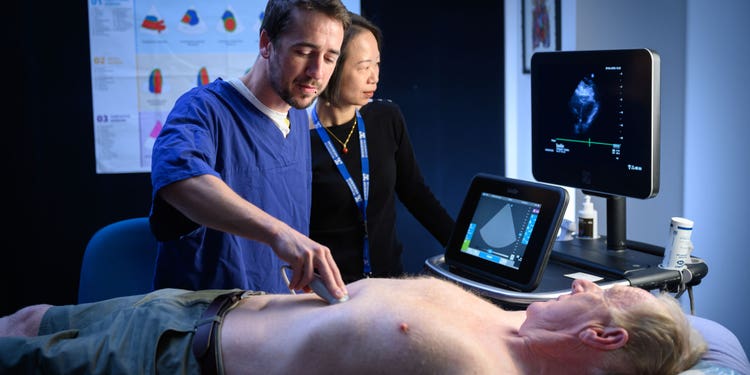
You will need to obtain practical experience at your institution or attend hands-on workshops to supplement your knowledge base, alternatively you could enrol in any of our practical workshops, giving you access to our innovative simulator room.
Course structure
The Graduate Certificate in Clinical Ultrasound is a 50-point program, designed to take six months if studying full time, or one year if undertaken part-time.
You must complete four subjects, each worth 12.5 points:
- One core subject
- Three electives.
Workload
- A part-time workload involves one to two subjects per semester, with an estimated 10 to 20 hours of study time per week.
- A full-time workload involves three to four subjects per semester and an estimated 30 to 40 hours of study time per week.
Clinical Ultrasound Pathways
Explore this course
Explore the subjects you could choose as part of this certificate.
Students must successfully complete a total of 12.5 credit points of core subjects
Option 1
| Accordion | |
|---|---|
| Principles of Ultrasound Heart Scan · 12.5 pts |
This subject will outline a physics related to medical ultrasound use; an introduction to transthoracic echocardiography using the focused assessment technique HEARTscan (Haemodyanmic Echocardiography Assessment in Real Time). Topics include:
|
Option 2
| Accordion | |
|---|---|
| Clinical Ultrasound – Core Concepts · 6.25 pts |
After completion of this subject, students will have the knowledge of the fundamentals of ultrasound generation and biosafety and infection control, equipment, management of images and how to seek and obtain competency, certification and credentialling in a desired field of clinical ultrasound. |
| Transthoracic Echocardiography (TTE) · 6.25 pts |
After completion of this subject, students will have the knowledge to acquire the focused transthoracic echocardiography (TTE) views, understand haemodynamic state assessment, perform limited valve assessment using two dimensional and colour flow Doppler, interpret common cardiac pathology identified with TTE and be able to write a focused TTE report. Students will have interpreted and written a report on 10 online focused TTE studies of a wide range of commonly encountered cardiac pathology. |
Students must successfully complete a total of 37.5 credit points of core subjects
| Accordion | |
|---|---|
| Doppler Echocardiography · 12.5 pts |
This subject will introduce Doppler echocardiography to complement basic transthoracic echocardiography imaging. Topics include:
|
| Ventricular Function · 12.5 pts |
This subject will expand the knowledge of transthoracic echocardiography by learning pathophysiology and assessment of ventricular function, including in diastolic function. Topics include:
|
| Ultrasound Guided Procedures · 12.5 pts |
This subject will outline the technique of using ultrasound to guide percutaneous procedures. Procedures will include vessel access, nerve blocks, and trauma related procedures. There will be an elective of either "Nerve Blocks" or "Critical Care Procedures". Topics include:
|
| Abdominal and Peri-Arrest Ultrasound · 12.5 pts |
In the subject, the student will learn about ultrasound assessment of the abdomen and learn to integrate abdominal, lung and cardiac ultrasound in the peri-arrest scenario. |
| Obstetrics Gynaecology and Practicum · 12.5 pts |
In the subject, the student will learn about basic ultrasound assessment of pregnant women, and for gynecological emergencies, as well as completing a logbook of 20 clinical cases. |
| Vessels Nerves Lungs and Musculoskeletal · 12.5 pts |
In the subject, the student will learn about ultrasound assessment of lung and musculoskeletal ultrasound and learn how to perform ultrasound guided vascular access and nerve blocks |
| 1st Trimester OBGYN Ultrasound · 6.25 pts |
Students will learn how to interpret focused clinical ultrasound assessment of early pregnancy problems and pelvic pain and how to write an interpretive ultrasound report. Students will critically interpret and write a report on 10 online focused early pregnancy and basic gynaecology ultrasound studies. |
| 2nd + 3rd Trimester OBGYN Ultrasound · 6.25 pts |
After completion of this subject, students will have the knowledge to perform and interpret focused second and third trimester ultrasound assessment and will be competent in writing interpretive reports. Students will have interpreted and written a report on 10 online pregnancy ultrasound studies including commonly encountered pathology. |
| Abdo/Gastrointestinal Ultrasound · 6.25 pts |
After completion of this subject, students will have the knowledge to interpret clinical ultrasound of commonly encountered pathology of the abdomen, including the gastrointestinal system (excluding the renal system), and will be able to write a focused ultrasound report. Students will have interpreted and written a report on 10 focused abdominal ultrasound studies of a wide range of commonly encountered pathology. Students will obtain knowledge of how to perform relevant ultrasound-guided procedures of the abdomen. |
| Breast Ultrasound · 6.25 pts |
After completion of this subject, students will have the knowledge to perform and interpret clinical ultrasound of the breast, implants, surrounding soft tissues and lymph nodes and be able to write a structured ultrasound report. Students will have interpreted and written a report on 10 ultrasound studies of a wide range of commonly encountered breast and soft tissue pathology. Students will have the knowledge how to use ultrasound to guide percutaneous procedures on the breast and soft tissues |
| Lung Sternum and Deep Venous Thrombosis · 6.25 pts |
After completion of this subject, students will have the knowledge to perform and interpret clinical ultrasound of commonly encountered pulmonary pathology, grade the degree of sternal mobility after open cardiac surgery, diagnose deep venous thrombosis of the lower limb and will be able to write a focused ultrasound report. Students will have interpreted and written a report on 10 online focused ultrasound studies. |
| Musculoskeletal Ultrasound · 6.25 pts |
After completion of this subject, students will have the knowledge to perform and interpret clinical ultrasound of commonly encountered pathology of the musculoskeletal system and external soft tissue and will be competent in writing interpretive reports. Students will have interpreted and written a report on 10 online ultrasound studies of a wide range of commonly encountered musculoskeletal and soft tissue pathology. Students will have the knowledge in how to perform ultrasound-guided percutaneous procedures on the musculoskeletal system. |
| Nursing and Junior Doctor Ultrasound · 6.25 pts |
After completion of this subject, students will have the knowledge for performing and interpreting focused ultrasound assessment of the lung, heart, sternum and bladder, and lower limb deep venous system for thrombosis. Students will have interpreted and written a report on 10 ultrasound studies and will have the knowledge to perform ultrasound-guided vascular access |
| Paediatric Ultrasound · 6.25 pts |
After completion of this subject, students will have the knowledge to acquire focused ultrasound views for basic assessment of the heart, lung, and abdomen in paediatrics and be able to write a focused ultrasound report. Students will have interpreted and written a report on 10 focused ultrasound studies of pathology relevant to paediatric practice. Students will have the knowledge to perform ultrasound guided peripheral venous and arterial catheterisation in paediatric patients. |
| Peri-arrest Ultrasound · 6.25 pts |
After completion of this subject, students will have the knowledge to perform a clinical ultrasound to help determine the common causes of shock and cardiac arrest (peri-arrest). The peri-arrest ultrasound examination builds on the extended focused abdominal sonography in trauma (eFAST) of the abdomen, heart and lungs to include assessment of non-traumatic shock and cardiac arrest including cardiac dysrhythmia, ventricular function and volume, pulmonary pathologies other than effusion as well as diagnosis of deep venous thrombosis of the lower limbs to assist in diagnosis of pulmonary embolus. Students will be able to write a focused ultrasound report. Students will have interpreted and written a report on 10 online peri-arrest ultrasound studies of a wide range of commonly encountered cardiac pathology. |
| Regional Anaesthesia · 6.25 pts |
After completion of this subject, students will have comprehensive knowledge of the sono-anatomy and when and how to safely perform ultrasound-guided regional anaesthesia blocks and insertion of catheters for the upper and lower limbs, thorax, abdomen, pelvis, head, and eye. |
| Renal Ultrasound · 6.25 pts |
After completion of this subject, students will have the knowledge to perform and interpret focused ultrasound of the renal tract and scrotum and will be able to write a focused ultrasound report. Students will have interpreted and written a report on 10 focused renal/scrotal ultrasound studies of a wide range of commonly encountered pathology. Students will obtain the knowledge of how to perform relevant ultrasound-guided procedures of the renal system. |
| Transoesophageal Echocardiography (TOE) · 6.25 pts |
After completion of this subject, students will have the knowledge of how to safely insert and clean a transoesophageal echocardiography (TOE) probe, to acquire the standard TOE views, interpret haemodynamic state and limited valve assessment using two dimensional and colour flow Doppler, interpret common cardiac pathology and be able to write a focused ultrasound report. Students will have interpreted and written a report on 10 focused TOE studies of a wide range of commonly encountered cardiac pathology. |
| Ultrasound Critical Care Procedures · 6.25 pts |
After completion of this subject, students will have the knowledge of when and how to perform ultrasound-guided percutaneous procedures commonly used in critical care, including central and peripheral venous and arterial vascular access, drainage of effusions from the lung, heart and peritoneal cavities, and ultrasound guided surgical airway procedures. |
| Ultrasound for Paramedics · 6.25 pts |
After completion of this subject, students will have the knowledge for how to use ultrasound to improve diagnosis and procedures for patients in the pre-hospital setting. Students will have the knowledge to perform a clinical ultrasound to help determine the common causes of shock and cardiac arrest (peri-arrest), including focused ultrasound assessment of the heart, lungs abdomen and deep venous thrombosis (peri-arrest), and vascular systems. Students will have interpreted and written a report on 10 ultrasound studies. Students will have the knowledge to perform ultrasound-guided critical care procedures such as intravenous cannulation, thoracostomy, and percutaneous cannulation of the trachea |
| Vascular Ultrasound · 6.25 pts |
After completion of this subject, students will have the knowledge to perform and interpret clinical arterial and venous vascular ultrasound and will develop a good ability in writing interpretive reports. Students will have interpreted and written a report on 10 ultrasound studies of a wide range of commonly encountered vascular pathology. Students will also have the knowledge in how to use ultrasound to perform ultrasound-guided percutaneous arterial and venous cannulation. |