Master of Arts and Cultural Management
Course code: 175AA
2 years full time / 4 years part time
1 or 1.5 years full time (or part time equivalent) with relevant prior qualifications
March, July
Commonwealth Supported Places (CSPs) available
Access Melbourne is available
March, July
AUD $48,992 (2026 indicative first year fee)
IELTS 6.5: with no band less than 6.0
Student experience
Overview
We will equip you with more than just an education. Learn from some of the country’s most influential teachers, access a network of innovative industry leaders and engage with our exciting internship opportunities.
Student profile – Abe Watson, Production Manager at the Melbourne Theatre Company
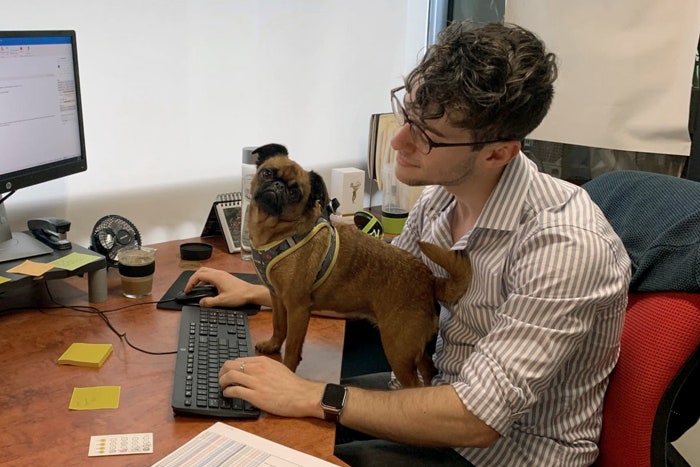
Abe Watson at work with Willow (Instagram: @willowvonruff) at the MTC. Photo credit: MTC
Abe Watson says that the arts is in his blood. Born and bred in Bendigo – where he still lives – Abe was involved in theatre from a very young age, eventually becoming part of the management committee at his local theatre company and serving there for ten years.
He’s now Production Manager at the Melbourne Theatre Company – and he’s also a current Master of Arts and Cultural Management student.
Although Abe had many years’ experience in the arts industry, he wanted to learn about the specific skills required to manage arts and cultural organisations in Australia.
“The skillsets needed in arts organisations are unique,” he explains, “and I felt this program would be better tailored to what I wanted to do, rather than an MBA or generic management degree”.
For Abe, the degree has reinforced knowledge gained from working in the industry for a long time.
“But it’s also highlighted the specific challenges which management in arts and cultural organisation face. This is extremely important, because the challenges in this sector are so different to general management challenges,” he explains. “It has also helped me better speak the economic language, and be able to contribute more confidently in budget and financial discussions, as well as weigh in with potential solutions to problems.”
Abe also sees the diversity of his peers as a huge benefit to his studies, calling the University’s multicultural and diverse student cohort “one of its superpowers”.
“Because of this [diversity], tutorial discussions are engaging, because people bring their own perspective, formed by their own experience. It’s fascinating learning about how things are different (or similar) in all different corners of the globe. It’s a great environment for learning and it pushes you to be your best,” he says.
“I always knew I was passionate about theatre and the arts, but I think this degree has reinforced in me why I continue to do what I do. It has also inspired me to (in my own little way) try to educate people around the importance of arts and culture – not just in an economic and instrumental sense – but in an intrinsic sense too.”