Master of Biostatistics
- #2 in Australia for Public Health (ShanghaiRanking)
- #17 in the world for Public Health (ShanghaiRanking)
Course code: 991AA

March, July
Commonwealth Supported Places (CSPs) available
March
AUD $62,976 (2026 indicative first year fee)
IELTS 6.5: with no band less than 6.0
Career outcomes
Overview
What are the career outcomes for Master of Biostatistics graduates?
With the rise of ‘Big Data’, expertise in biostatistics has never been more crucial. Whether you're helping to answer key questions about disease prevention or improving patient treatment, a Master of Biostatistics at the University of Melbourne will build your practical skills for working with data and deepen your theoretical understanding of statistics. This degree will set you on a path to become a leader in this vital field.
What are the top career paths after completing the Master of Biostatistics?
- Become a biostatistician. Step into a rapidly growing field and learn to transform complex data into clear insights that drive new discoveries and improve public health.
- Contribute to research. Unlock worldwide career opportunities or pursue further research, like a PhD.
What is the expected salary for Master of Biostatistics graduates?
The expected entry level salary for a Master of Biostatistics graduate working as a biostatistician is $100,000-110,000 plus super.
The average salary after 3-4 years for a Master of Biostatistics graduate is $120,000-145,000 plus super.
(Source: Economic Research Institute 2026).
What can you do with a Master of Biostatistics?
This Master of Biostatistics opens up a wide range of exciting national and international employment opportunities. While you'll cover all the necessary statistical theory throughout your degree, the focus will be on applying this knowledge to current health problems. Your skills as a professional biostatistician will prepare you for careers in diverse and impactful environments, such as:
- Medical and public health research centres like the Murdoch Children's Research Institute and the Doherty Institute for Infection and Immunity.
- Universities like the University of Melbourne and others in Australia and around the world.
- Hospitals like The Royal Melbourne Hospital and the Royal Children’s Hospital.
- Government departments like the Australian Bureau of Statistics and the Department of Health, Disability and Ageing.
- Pharmaceutical companies and clinical research organisations like Pfizer.
What accreditation does the Master of Biostatistics provide?
This Master of Biostatistics is an internationally accredited degree. Upon graduation, a Master of Biostatistics can lead to accreditation with the Statistical Society of Australia (SSA), making you highly employable across the globe.
How does the Master of Biostatistics help to make industry connections?
Enjoy a range of opportunities to gain experience and build relationships in industry.
- Access well-connected industry professionals, helping to link you to prospective employment networks and other institutions.
- Complete your research project within the Melbourne Biomedical Precinct, meeting many professionals in the field.
- Connect with other prestigious universities in Australia through the Biostatistics Collaboration of Australia.
What career support services are available for Master of Biostatistics students?
Plan and achieve your goals with our career support services. Access these services to build your confidence and improve your career readiness while studying.
Support includes:
- Private LinkedIn group with job listings, PhD opportunities, and workshops just for Biostatistics students.
- Personalised career consultations.
- Workshops on resume writing, LinkedIn optimisation, and interview skills.
- Networking events with alumni and professionals.
University of Melbourne alumni profile
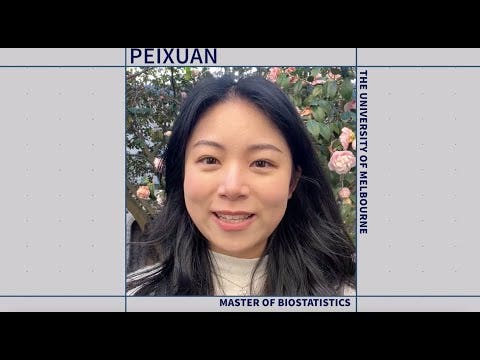
Meet Peixuan, a Master of Biostatistics graduate who is now working as a biostatistician at the Centre for Epidemiology and Biostatistics. Learn how the combination of research projects and real-world scenarios prepared her for a fulfilling career, while the tight-knit cohort helped her enjoy her time as a student.
What further study options are available after this course?
Make a difference through graduate research
The Master of Biostatistics is an ideal stepping stone for further academic study, especially if you're considering a PhD. This program provides a strong foundation for continued research and a career in academia.