Master of Clinical Audiology
Course code: 305BB
March
Commonwealth Supported Places (CSPs) available
Access Melbourne is available
March
AUD $68,992 (2026 indicative first year fee)
IELTS 7.0: with no band less than 7.0
Career outcomes
Overview
What are the career outcomes for Master of Clinical Audiology graduates?
The Master of Clinical Audiology is internationally recognised and connects you to global clinical and research networks. Graduates pursue diverse roles in clinical practice, health management, leadership, education and research, supported by intensive hands‑on training and industry partnerships. With strong employer demand —over 80% of graduates secure employment before graduation (Graduate Survey 2025)— you will graduate career‑ready to lead in hospitals, private practice and community health.
What are the top career paths after completing the Master of Clinical Audiology?
- Become an audiologist. Provide clinical assessment, hearing‑aid fitting, and vestibular care and rehabilitation in Australia or overseas.
- Research and academia. Drive innovation at the same university that created the cochlear implant through graduate research.
- Hospital management and leadership. Help share your knowledge through leadership and teaching opportunities.
What is the expected salary for Master of Clinical Audiology graduates?
The expected entry level salary for a Master of Clinical Audiology graduate is $95,000 plus super. This can be higher for regional or international opportunities that have relocation costs.
The average salary after 3-4 years for a Master of Clinical Audiology graduate is $100,000 plus super.
(Source: Graduate Survey 2025).
What can you do with a Master of Clinical Audiology?
No matter your path, you’ll graduate with clinical assessment, diagnostics, counselling, device fitting and interprofessional teamwork skills. Employers value your evidence‑based practice, client‑centred care and adaptability; strong industry demand supports roles in clinical services, health management, medical device companies and community programs.
Employers in this field include:
- Hospitals and clinics.
- Private practice on your own or as part of an interprofessional team.
- Private hearing‑aid providers.
- Universities and research institutes.
- Medical device companies for hearing aids and cochlear implants.
- Community centres in metropolitan, regional, and remote areas.
What accreditation does the Master of Clinical Audiology provide?
The Master of Clinical Audiology is a fully accredited degree, with graduates eligible for membership of Audiology Australia upon graduation. It is also internationally accredited, with graduates successfully finding work in the UK, Canada, New Zealand and Singapore.
How does the Master of Clinical Audiology help to make industry connections?
Enjoy a range of opportunities to gain experience and build relationships in industry.
- Complete clinical placements with a range of industry partners including hospitals, private clinics and community hearing services.
- Join networking events, the student conference and informal coffee chats.
- Connect with alumni, students, clinicians, researchers, and community members at our flagship event, the Audiology Annual Conversation.
- Receive mentorship and professional supervision from academic and clinical leaders.
- Participate in international placements in Japan, Chile, New Zealand, Thailand, Malawi, Hong Kong and Singapore.
- Engage with professional bodies such as Audiology Australia for CPD and employment opportunities.
- Present research and attend sector conferences to raise your professional profile and expand contacts.
What career support services are available for Master of Clinical Audiology students?
Plan and achieve your goals with our career support services. Access these services to build your confidence and improve your career readiness while studying.
Support includes:
- Personalised career consultations
- Audiology-specific workshops on resume writing, industry networking, and interview skills
- Access to an exclusive job portal connecting students to industry opportunities
- Networking events with alumni and professionals
What further study options are available after this course?
The program offers an avenue for further PhD studies within the Department for students who demonstrate an aptitude for research. Previous graduates have been at the forefront of research and practice in numerous specialist areas, such as:
- Hearing in classroom education and childhood development
- Age-related changes in the central auditory system
- Innovations in hearing devices and surgery
- Auditory function in people with different conditions
- Service delivery and patient care
Graduates have also completed medical school, a Master of Business Administration, or a Master of Public Health.
Profile
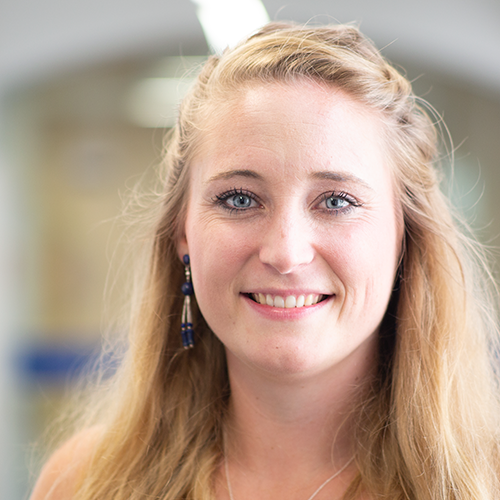
Emma Webb
After working as an exercise physiologist for five years I was ready for something new. I still wanted to help people and I was after a scientific challenge, so I chose audiology.
I have hearing loss myself (I have cochlear implants) so growing up I visited the audiologist a lot. Back then I didn’t think I’d make it a career though!
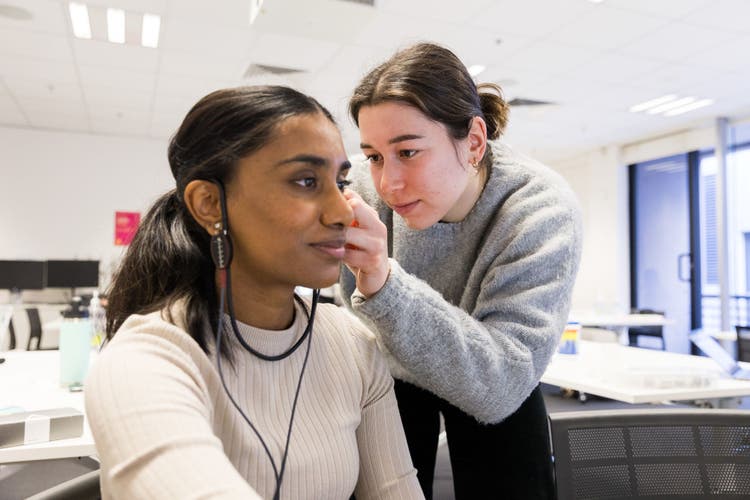
The course is very placement oriented, so you get good exposure to lots of different aspects of audiology, from paediatrics to adult diagnostics and rehab. And because the University has a teaching clinic, we often did placement with our lecturers and supervisors which was really beneficial.
I came in thinking I wanted to work with cochlear implants but the placements exposed me to so many more options, and helped me realise audiology is much more diverse than I first thought.
The teaching was wonderful. My supervisors were really passionate and incredibly supportive. And the other students were great too – it’s a small cohort so you get to know everyone, and you do placement in pairs so we all ended up quite close.
A highlight for me was spending a week volunteering in Cambodia. We worked at the children’s surgical centre with the local ear, nose and throat specialist and audiology nurses. It was very hard work but definitely a life-changing experience.
I’ve just finished the course and now I’m doing a PhD, balancing my time between working in clinic and doing research with the Murdoch Children’s Research Institute. We’re looking into developing a screening tool for newborns to detect cytomegalovirus – a virus that’s the leading infectious cause of permanent hearing loss in babies.
I love balancing research and clinical work. I’ve definitely found the challenge I was looking for.
Graduate pathways
Once you've completed your undergraduate degree, you can go on to gain employment or begin a graduate degree and work towards a professional qualification such as law, engineering or medicine. Or you could join our graduate research community and contribute to our world-changing research.
Your graduate degree will be internationally recognised, and set you apart from those who study a traditional Australian single or double degree.
Explore the graduate pathways available once you complete your undergraduate degree here.