Master of Cultural Materials Conservation
Course code: MC-CULMC
2 years full time / 4 years part time
1 or 1.5 years full time (or part time equivalent) with relevant prior qualifications
February
Commonwealth Supported Places (CSPs) available
Access Melbourne is available
February
AUD $48,992 (2026 indicative first year fee)
IELTS 6.5: with no band less than 6.0
Student experience
Overview
We will equip you with more than just an education. Learn from some of the country’s most influential teachers, access a network of innovative industry leaders and engage with our exciting internship opportunities.
Graduate profile: Saiful Bakhri – Conservator, Bali Cultural Heritage Preservation Office
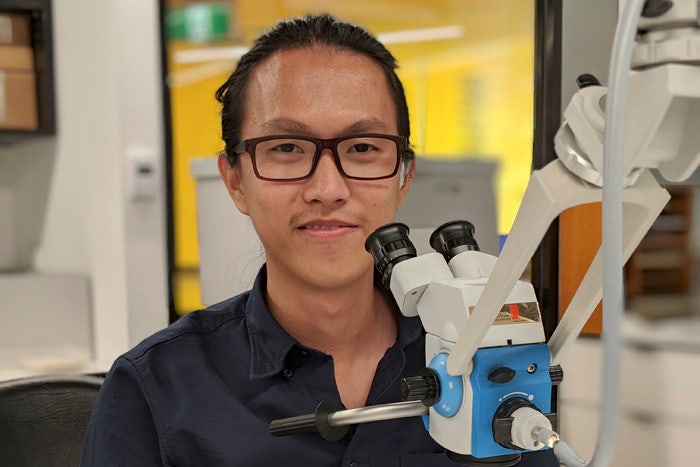
After studying archaeology in Indonesia, Saiful Bakhri came to Melbourne to undertake the Master of Cultural Materials Conservation. Having observed that Indonesia had a lack of conservators despite an abundance of cultural artefacts, he hoped that through his studies he would develop knowledge and skills which he could take back home.
“The program has expanded my horizon on cultural materials conservation, from theory on what we do and why we do it, to the practical experience on handling, observing, treating, and housing objects,” he says.
“Conservation happens not only in the laboratory but also in the field,” he explains. “The degree prepared me with cross-cultural skills that are crucial for conservators in the 21st century, and the knowledge that significant objects are not only located in formal institutions, but within communities.”
Now a conservator at the Bali Cultural Heritage Preservation Office, his work concerns the preservation of cultural heritage for Bali, West and East Nusa Tenggara, and he deals with objects such as beaten-bark paintings and manuscripts, traditional houses, and prehistoric human remains.