Specialist Certificate in Disaster and Terror Medicine
Course code: SC-DTM
January
AUD $10,248 (2026 indicative first year fee). Commonwealth Supported Places (CSPs) are not available
January
AUD $10,496 (2026 indicative first year fee)
IELTS 7.0: with no band less than 6.5
Course structure
Overview
What will you learn?
In this program you will develop key problem-solving skills and expertise in this specialist area, including logistical and clinical prevention, planning, response, recovery and policy development. You will also gain an understanding of domestic and international factors involved in the management of these events.
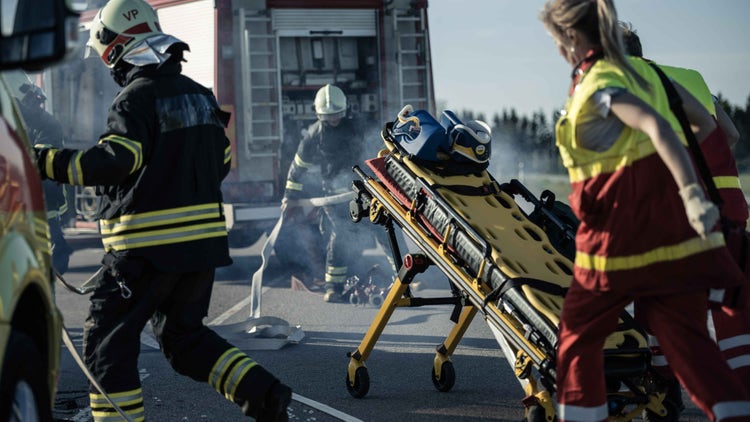
The course is delivered online, with two, two-day face-to-face workshops (4 days in total) involving practical exercises and simulation activities. Led by internationally renowned experts from a range of backgrounds, in this practical component you will apply your newly acquired integrated knowledge to solving problems in various simulated disaster situations. This includes active shooter mass casualty simulations, drill exercises and hazardous materials training. It is highly recommended students attend campus for these workshops, but they may attend virtually.
On completion of this course, you will be able to:
- Recognise and apply disaster and terror medicine and health management principles, considering the various health systems and challenges in managing disaster incidents and countering terrorism
- Analyse the factors that underpin level of organisational response and the principles that are applied to prevent, manage, contain and diffuse the impact of disasters in clinical settings
- Devise methods to address the complex physical and psychological factors involved in after care and recovery post event
- Develop creative and flexible problem-solving, communication skills for unique crisis situations, in a range of environmental, geographic and often dangerous settings
- Evaluate the clinical and health service design and implementation processes for prevention, planning, responding and managing disaster and terror events
- Critically assess the clinical and health service risk and the impact of disaster and terror events.
Workload
This course can be completed in six months of part-time study.
The expected workload is approximately 20 hours per week, including all readings and assessments.
Teaching dates for face-to-face workshops
Explore this course
Explore the subjects you could choose as part of this certificate.
| Accordion | |
|---|---|
| Disaster Medicine Principles & Responses · 12.5 pts |
This subject will provide the student with the key skills and knowledge required to evaluate the nature and extent of disaster events from a clinical and healthcare management perspective. Students will learn to apply existing models of preparedness, and plan the various levels of response (community, health service, national and global), as well as consider resource utilisation, resilience and recovery. Students will engage with authentic cases and simulations to develop management strategies for a range of disaster situations. Topics covered will include:
Teaching/learning formats include:
The informal exchange of insights and experiences among participants is a key aspect of learning. |
| Terror Medicine Principles & Responses · 12.5 pts |
This subject will provide essential skills and knowledge for recognising and responding to specific terror events and their corresponding clinical and health service management. Students will learn to apply relevant frameworks for evaluating terror events. They will practise planning and applying management strategies to authentic scenarios and simulations, developing problem solving and communication skills relevant to extreme conditions and crisis situations. Topics covered will include:
Teaching/learning formats include:
|