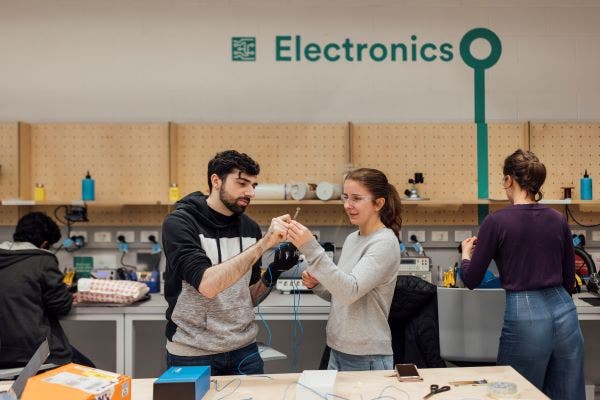
Major structure
Overview
This major is available in the Bachelor of Science.
In the Electrical Engineering Systems major, you’ll model, design and connect the systems that power modern life. From renewable energy grids and smart infrastructure to autonomous vehicles, electronic devices and communication networks, you’ll see how signals, electronics and digital computing come together to solve problems at scale.
Major structure
The Electrical Engineering Systems major is made up of eight subjects (100 credit points) taken in your second and third year. Each subject is worth 12.5 credit points. Level 2 subjects are usually taken in second year, and Level 3 subjects in third year.
To complete this major, you’ll need:
- 50 credit points of Level 2 major core
- 37.5 credit points of Level 3 major core
- 12.5 credit points of Level 3 capstone
The rest of your degree will consist of a Level 1 science core subject, your choice of elective subjects in science, and breadth (non-science) subjects.
Further information
You can find detailed information about your major – including structure, subject availability, and participation requirements – in the Handbook.
You can also explore your study pathway and sample course plans through My Course Planner.
Sample course plan
View some sample course plans to help you select subjects that will meet the requirements for this major.
Electrical Engineering Systems Start-year intake
If you did not achieve a study score of at least 29 in VCE Specialist Mathematics 3/4, you may need to enrol in MAST10005 Calculus 1 in your first semester. If you achieved a study score of at least 36 in VCE Specialist Mathematics 3/4 or equivalent, you can enrol in MAST10021 Calculus 2: Advanced and MAST10022 Linear Algebra: Advanced instead of MAST10006 Calculus 2 and MAST10007 Linear Algebra. If you did not achieve a study score of at least 29 in VCE Units 3/4 Physics, you may need to enrol in PHYC10009: Foundations of Physics in your first semester.
Year 1
100 pts
Year 2
100 pts
Year 3
100 pts
Explore this major
Explore the subjects you could choose as part of this major.
Complete all the following subjects:
| Accordion | |
|---|---|
| Electrical Network Analysis and Design · 12.5 pts |
AIMS This subject develops a fundamental understanding of linear time-invariant network models for the analysis and design of electrical and electronic systems. Such models arise in the study of systems ranging from large-scale power grids to tiny radio frequency signal amplifiers. This subject is one of four subjects that define the Electrical Systems Major in the Bachelor of Science and it is a core requirement for the Master of Engineering (Electrical). It provides a foundation for various subsequent subjects, including ELEN30013 Electronic System Implementation, ELEN90066 Embedded System Design, and ELEN30012 Signal and Systems. Topics include:
These topics will be complemented by tutorials and workshops designed to develop skills in design and modelling of electronic circuits through software tools and building, testing, and verification of electronic circuits. Please view this video for further information: Electrical Network Analysis and Design |
| Electrical Device Modelling · 12.5 pts |
AIM This subject develops the theoretical and practical tools required to understand, construct, validate and apply models of standard electrical and electronic devices. In particular, students will study the theoretical and practical development of models for devices such as resistors, capacitors, inductors, transformers, motors, batteries, diodes, transistors, and transmission lines. In doing so, students will gain exposure to a variety of fundamental fields in physics, including electromagnetism, semiconductor materials and quantum electronics. This material will be complemented by exposure to experiment design and measurement techniques in the laboratory, the application of models from device manufacturers, and the use of electronic circuit simulation software. Topics include: Vector calculus for device modelling, Maxwell’s equations, physics of conductors and insulators, passive device models (including for resistors, capacitors and inductors), lumped and distributed circuit models for wired interconnections (including treatment of signal integrity and termination strategies), semiconductors and quantum electronics, static and dynamic models for p-n junctions diodes and bipolar junction transistors. |
| Signals and Systems · 12.5 pts |
AIMS INDICATIVE CONTENT |
| Electronic System Implementation · 12.5 pts |
AIMSThis subject provides students with hands-on electronic skills to gain basic competencies in design and implementation of simple circuits. Students will design with a range of standard electrical and electronic devices, basic circuit construction methods and electrical measurement techniques to test and verify the function of electronic systems. This subject is one of four subjects that define the Electrical Systems Major in the Bachelor of Science and it is a core requirement for the Master of Engineering (Electrical) and the Master of Engineering (Electrical with Business). Students will complete electronic circuit implementation projects in small groups and be required to prepare technical documentation and present project outcomes. INDICATIVE CONTENT |