Major structure
Overview
Learn about the foundations of design and how they can be applied in sound, light and space.
Your major structure
This major can be completed through the Bachelor of Design.
The Bachelor of Design course structure results in a flexible degree that allows students to explore different fields of study. You can choose your major immediately or make a decision before the beginning of second year.
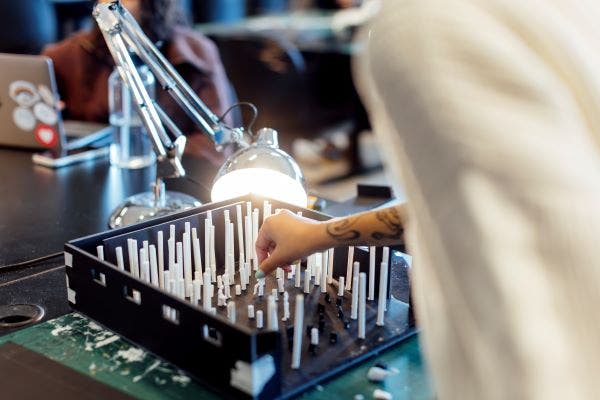
In the first year of the Bachelor of Design, you will be immersed in a world of design and discovering new concepts and skills. You might be performing on a stage, writing code in a computer lab, contemplating design theory and putting it in to practice, or making 3D models. The subjects you complete in your first year provide the basis for your knowledge of design that will carry through for the rest of your degree.
By your second year you will deepen your understanding of your chosen design disciplines and be able to finalise your selection of majors, minors and specialisations.
In third year you will complete your major requirements. You will also be required to undertake a capstone subject. Capstones are designed to draw together the various theoretical strands. On the completion of third year graduates will possess strong written, oral and visual communication techniques, and will develop practical skills and apply these to problem-solving.
You can take a the following double major options with the Bachelor of Design:
- Performance Design + Civil Systems
- Performance Design + Computing
- Performance Design + Construction
- Performance Design + Digital Technologies
- Performance Design + Graphic Design
- Performance Design + Landscape Architecture
- Performance Design + Mechanical Systems
- Performance Design + Property
- Performance Design + Spatial Systems
- Performance Design + Urban Planning
BREADTH STUDIES
Breadth is a unique feature of the Melbourne Model. It gives you the chance to explore subjects outside of science or design, developing new perspectives and learning to collaborate with others who have different strengths and interests — just as you will in your future career.
Some of our students use breadth to explore creative interests or topics they have always been curious about. Others used breadth to improve their career prospects by complementing their major with a language, communication skills or business expertise.
Sample course plan
View some sample course plans to help you select subjects that will meet the requirements for this major.
| Accordion | |
|---|---|
Year 1100 pts |
|
| Semester 1 · 50 pts |
|
| Semester 2 · 50 pts | |
| Accordion | |
|---|---|
Year 2100 pts |
|
| Semester 1 · 50 pts |
|
| Semester 2 · 50 pts |
|
| Accordion | |
|---|---|
Year 3100 pts |
|
| Semester 1 · 50 pts | |
| Semester 2 · 50 pts |
|
| Accordion | |
|---|---|
Year 1100 pts |
|
| Semester 1 · 50 pts | |
| Semester 2 · 50 pts | |
| Accordion | |
|---|---|
Year 2100 pts |
|
| Semester 1 · 50 pts | |
| Semester 2 · 50 pts | |
| Accordion | |
|---|---|
Year 3100 pts |
|
| Semester 1 · 50 pts | |
| Semester 2 · 50 pts | |
| Accordion | |
|---|---|
Year 1100 pts |
|
| Semester 1 · 50 pts | |
| Semester 2 · 50 pts | |
| Accordion | |
|---|---|
Year 2100 pts |
|
| Semester 1 · 50 pts | |
| Semester 2 · 50 pts | |
| Accordion | |
|---|---|
Year 3100 pts |
|
| Semester 1 · 50 pts | |
| Semester 2 · 50 pts | |
| Accordion | |
|---|---|
Year 1100 pts |
|
| Semester 1 · 50 pts | |
| Semester 2 · 50 pts | |
| Accordion | |
|---|---|
Year 2100 pts |
|
| Semester 1 · 50 pts | |
| Semester 2 · 50 pts | |
| Accordion | |
|---|---|
Year 3100 pts |
|
| Semester 1 · 50 pts | |
| Semester 2 · 50 pts | |
Explore this major
Explore the subjects you could choose as part of this major.
Students must complete all of the following subjects
| Accordion | |
|---|---|
| Light in Performance · 12.5 pts |
Light is an essential ingredient in any performance – without light there is nothing to see. This subject examines how through the use of colour, texture, rhythm and intensity, light can be used as a dramaturgical tool in the development of a performance, and explores the close relationship lighting has with the other design elements in performance. Through a series of lectures and studios, students will be introduced to light in performance across a range of forms such as; opera, music theatre, dance and drama, and how light interacts with the other design elements and the performer. |
| The Figure in Performance · 12.5 pts |
The figure is one of the elements available to be manipulated by the designer in the development of a design for performance. An audience reads (either consciously or unconsciously) that figure through its relationship to its environment, and how it presents itself to the viewer. The human figure is in some ways the only element in a design that is non-negotiable in terms of scale, however it can be transformed through costume design, its relationship to space, its relationship to light and as represented through the puppet. Through a series of lectures and studios, this subject examines how this manipulation can be used as a dramaturgical tool in the creation of a performance. |
| Space Studio · 12.5 pts |
The focus of this studio subject is the development of both design thinking and dexterity with tools – specifically the generation and articulation of design possibilities through a series of studio based projects. Linking these investigations will be the theme of space in performance, which may be explored conceptually, metaphorically, structurally, or technologically – for example through an examination of the designed performance space and the found performance space, the use of scale in space, the potential for space to be ambiguous, the manipulation of space through the use of technology and the relationship of light and space. In all of these investigations, the student will be encouraged to think of space as a dramaturgical tool. |
| Space in Performance · 12.5 pts |
Space is one of the elements available to be manipulated by the designer in the development of a design for performance. Space can be expanded and compressed, altered and changed through the use of scenic elements and devices - the set. This subject examines how through the application of scenic devices and mechanisms, space can be used as a dramaturgical tool in the creation of a performance. Students will also study different performance spaces from different periods – their physical structure, and the theories underlying them. Non-traditional spaces will also be examined – the found performance space, and the site specific performance space. |
| Performance Design Studio · 25 pts |
This is the capstone subject for the Performance Design major in the Bachelor of Design, and will integrate previous coursework in the major. The core of the undergraduate sequence in the major is the development of both design thinking and dexterity with tools. The focus of the investigations of this capstone subject will be performance design, using a text (a play text, a piece of music, a piece of choreography, a soundscape) and a set of circumstances (the brief), which will be explored by students through the lens of two or more of the previous design studios. The project will involve an engagement with historical, theoretical, structural, and environmental ideas relevant to the text. |