Microbial Genomics: Bioinformatic Analysis Basics
Sorry you missed this course in 2026. Register your interest below for 2027: Gain practical skills in cutting-edge bioinformatics techniques and investigate microbial sequence data.
$990.00 AUD (inc GST)

What you will learn
Gain contemporary skills and knowledge for your job now.
Microbial genomics is revolutionising clinical and public health responses to communicable diseases. Advances in bioinformatics are enabling precise, real-time responses to pathogen outbreaks.
This micro-credential is ideal for infectious diseases professionals seeking a strong grounding in bioinformatics concepts and practical experience investigating microbial sequence data.
This course is co-designed and delivered in partnership with the Peter Doherty Institute for Infection and Immunity.
Understand quality control theory
Understand the importance of sequence data quality control and its impact on data analysis and interpretation in microbial genomics.
Explore fundamental bioinformatics theory
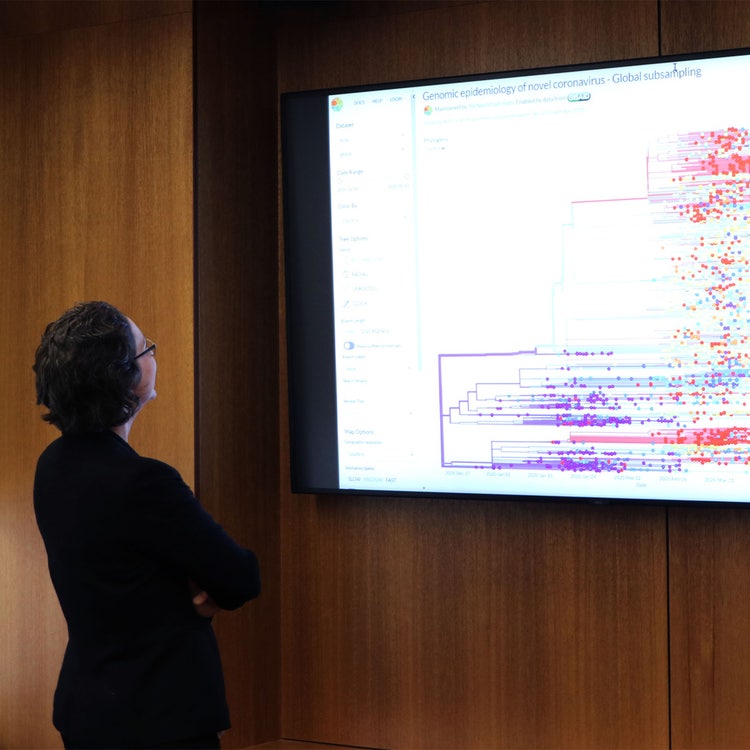
Gain a high-level understanding of bioinformatics theory, including the concepts of genome assembly, annotation, genome characterisation, mapping variant calling, and phylogenetics.
Gain practical experience in bioinformatics analysis
Analyse sequence data in the online genomics platform, Galaxy. Develop skills to critically assess which analysis approach and bioinformatics tools to use in different scenarios.
Apply bioinformatics to interrogate data from real-world case studies
Combine your new theoretical and practical knowledge to assess data and address questions arising from real-world case studies.
Who you will learn from
Learn from skilled academics and professional experts who will share invaluable knowledge you can use in your job.

Professor Tim Stinear
Scientific Director of the Doherty Applied Microbial Genomics research centre
Tim is a molecular microbiologist and research-teaching academic. He leads a team of scientists focused on understanding how certain types of bacteria spread and cause disease. In addition, he is the Scientific Director of the Doherty Applied Microbial Genomics research centre and a National Health and Medical Research Council Senior Fellow.

Dr Claire Gorrie
Research Fellow, Centre for Pathogen Genomics, University of Melbourne at the Doherty Institute
Dr Claire Gorrie is an early career researcher whose work focuses on developing genomic techniques for studying the evolution and transmission of antimicrobial resistant pathogens both in healthcare facilities and the wider community. During her PhD, she studied Klebsiella pneumoniae, and has since expanded her scope to include a range of bacterial pathogens such as Enterococcus faecium, Escherichia coli, Staphylococcus aureus, and Neisseria gonorrhea.

Dr Sarah Baines
Research Fellow, Centre for Pathogen Genomics, University of Melbourne at the Doherty Institute
Sarah is an early career researcher specialising in microbiology and genomics, as applied to understanding the development and spread of antimicrobial resistance (AMR). For her PhD, she investigated the population and functional genomics of drug-resistant lineages of Staphylococcus aureus. She continues to research S. aureus population dynamics, more recently expanding to other bacterial pathogens of public health interest to understand complex mechanisms of AMR.
More from this series
Take multiple courses to deepen your knowledge or stack towards a full degree.
The Applied Pathogen Genomics series
This series is designed for infectious diseases professionals seeking practical skills in the groundbreaking areas of pathogen genomics and bioinformatics. Taught by leading genomics experts, it will equip you with the capacity to analyse and use genomic data in your own practice.
Explore more from the Applied Pathogen Genomics series:
- Microbial Genomics: DNA Sequencing Basics (Micro-credential)
Fees
For individuals
To take Microbial Genomics: Bioinformatic Analysis Basics as a stand-alone Melbourne MicroCert, you'll pay the normal course price.
$990.00 AUD (inc GST)
Please contact Student Support to discuss discounts and payment options for University of Melbourne staff or alumni, or to pay by invoice.
For teams
If you have three or more team members who are keen to upskill with Microbial Genomics: Bioinformatic Analysis Basics, get in touch to discuss pricing. For large groups, we can also deliver and contextualise this course exclusively for your organisation.
Dates
Dates not right for you?
Register to receive updates
Course details
Want to know more about micro-credentials? See our Frequently Asked Questions
This course is designed for infectious diseases professionals seeking a fundamental understanding of bioinformatics and how it applies microbial genomics.
It's ideal for infectious diseases physicians, medical registrars, medical microbiologists, epidemiologists, public health physicians, laboratory scientists, as well as other health professionals.
There are no eligibility requirements.
This course is delivered in partnership with the Microbiological Diagnostic Unit Public Health Laboratory and Doherty Applied Microbial Genomics research centre.
This unique industry alignment means you can be confident your learning is contemporary and based on real-world industry needs.
By the end of this course, you'll be able to:
- Explain bioinformatics theory as applied to microbial genomics (with a focus on high-level concepts, quality control and impact on data analysis, and use of pipelines).
- Explain and undertake genome assembly, annotation and genome characterization analyses (focus on use of these approaches for identifying and investigation of genes and genomic structures, speciation and use of databases)
- Explain and undertake sequence read mapping and variant calling analyses (with a focus on use of these approaches for identifying and investigating antimicrobial resistance mutations)
- Explain and undertake basic phylogenetic analyses (focus on use of this approach for outbreak investigation)
This course runs over four weeks, including self-directed learning, guided learning, and two weeks to complete assessment tasks.
Your total time commitment is approximately 40 hours, which includes:
- 2 live session webinars
- 4 module drop-in sessions
- 2 assessment task drop in sessions
- 4 hours self-directed learning
- 16 hours assessment tasks
Assessment:
- Application of bioinformatic analysis approaches to diverse scenarios (40%)
- Independent analysis of pathogen genomic data (60%)
Microbial Genomics: Bioinformatics Analysis Basics can be taken as a stand-alone course or complemented with any other course in the Applied Pathogen Genomics series to deepen your knowledge and skills.
The series includes:
- Microbial Genomics: DNA Sequencing Basics
- Microbial Genomics: Bioinformatic Analysis Basics
- Microbial Genomics: Applications for Public Health
- Microbial Genomics: Applications for Clinical Sciences.
It is recommended you complete Microbial Genomics: DNA Sequencing Basics as the first offering in the series, then proceed to this one before completing the rest.
This course is predominantly self-directed learning, with opportunities to engage with your cohort and field experts, providing both flexibility and support.
You’ll work through written and recorded materials at your own pace, participate in group discussions, and receive valuable guidance and feedback from your course facilitators.
You’ll also complete practical activities, including the use of an online genomics platform, Galaxy, to begin to apply your knowledge of bioinformatics.